NIS2 scoping
Scoping answers the first question every organisation has: does NIS2 apply to us, and as what? Reglyze classifies you as an essential entity, an important entity, or out of scope, and records the reasoning.
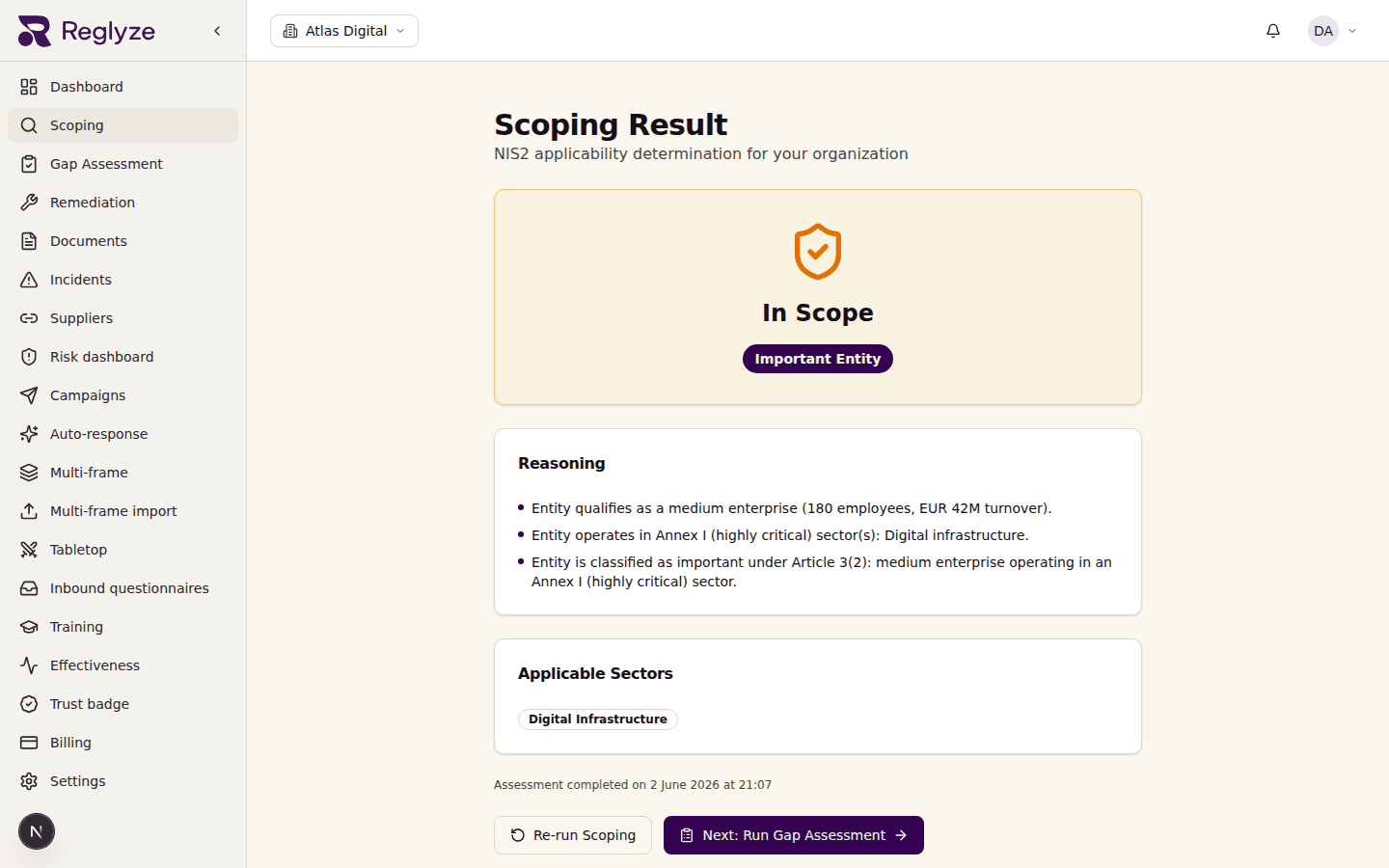
How classification works
NIS2 scope is a function of three things:
- Sector — whether you operate in an Annex I (“sectors of high criticality”) or Annex II (“other critical sectors”) sector.
- Size — the medium/large-enterprise thresholds (headcount and turnover/balance-sheet), with sector-specific exceptions where size doesn’t matter.
- Member-state designation — some entities are designated essential regardless of size by their national authority.
Reglyze walks you through these and produces a classification with the inputs that drove it, so an auditor can see why you concluded what you did.
Guided vs. conversational scoping
You can complete scoping as a structured questionnaire or via the AI-assisted conversational flow, which asks follow-up questions in plain language and infers the structured answers. Both produce the same recorded classification.
Why it matters downstream
Your classification sets the obligations that follow — the Article 21 measures you’re assessed against, the Article 23 incident-reporting duties, and the registration expectations with your national authority. Re-run scoping whenever your size, sector activities, or a member-state designation changes.
Auto-scoping enrichment
For digital-facing organisations, Reglyze can enrich scoping from your public web presence (domain, exposed services) to suggest in-scope systems — a starting point you confirm, never an automatic decision.