Gap assessment
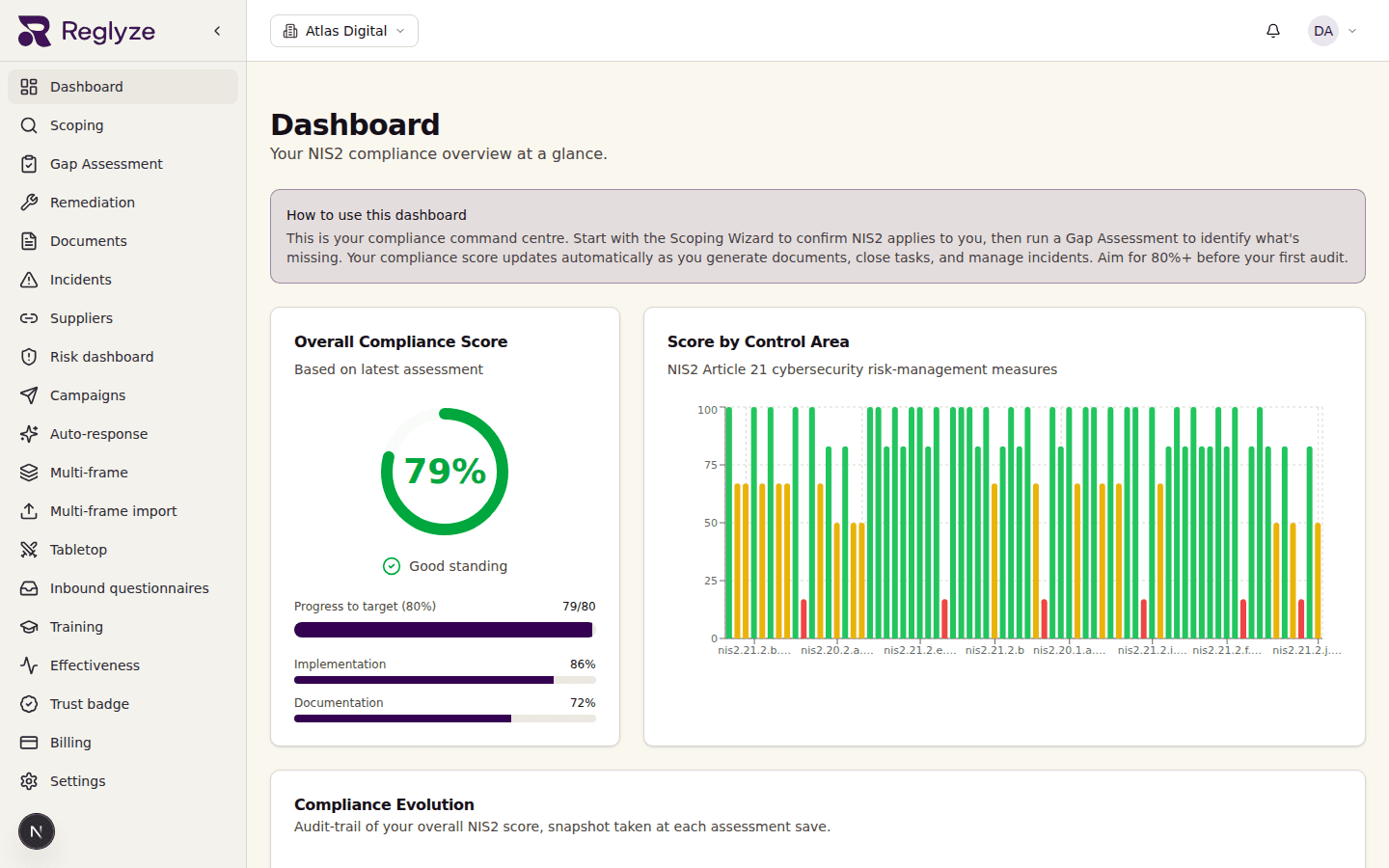
The gap assessment measures where you stand against the NIS2 Article 21 cybersecurity risk-management measures and turns the result into a prioritised plan.
What’s assessed
Article 21(2) sets out the baseline measures every in-scope entity must take — risk analysis and information-system security policies, incident handling, business continuity and crisis management, supply-chain security, secure acquisition and development, policies to assess effectiveness, basic cyber hygiene and training, cryptography, access control and asset management, multi-factor authentication and secure communications.
Reglyze breaks these into controls and sub-controls and scores each on two axes:
- Implementation — is the measure actually in place?
- Documentation — can you evidence it?
National transposition
NIS2 is an EU directive: it applies through each member state’s own law, and several national authorities publish a control framework that maps onto the Article 21 measures. Reglyze scores you against the Article 21(2) baseline — the common core — so the same evidence carries over to the framework that applies to you:
- France — ANSSI’s ReCyF (Référentiel Cyber France): mandatory security objectives (the “what”) plus recommended measures (the “how”) that are a recognised way to demonstrate compliance to ANSSI.
- Germany — the BSI under the NIS2-Umsetzungsgesetz (NIS2UmsuCG), with IT-Grundschutz as the established methodology.
- Italy — ACN under D.Lgs 138/2024, which sets the baseline security measures and the notification duties.
- Portugal — the CNCS and the Quadro Nacional de Referência para a Cibersegurança (QNRCS).
Where a national framework adds or refines a measure, treat your gap-assessment scores as the starting evidence base rather than the final word.
Scoring & severity
Each control gets an implementation and documentation score; together they roll up to an overall posture score and a per-control severity (how urgent the gap is). The dashboard shows the distribution so you can see at a glance whether you’re dealing with a few critical holes or broad shallow ones.
From gaps to a plan
Every gap can feed a remediation task with an owner, a due date, and a severity — so the assessment isn’t a static report but the start of a tracked work list. See Policies & documents for generating the artefacts a gap calls for, and Multi-framework to see the same work mapped to ISO 27001 / NIST CSF / DORA.
Re-assessing
Run the assessment periodically and after material change. NIS2 Article 21(1) expects measures to be kept effective over time — trend your scores to evidence that.